Does natural selection do metaphysical work?
When we make biological evolution the engine that "actualizes" mind ever more fully, we should ask what we're actually observing to justify the claim.

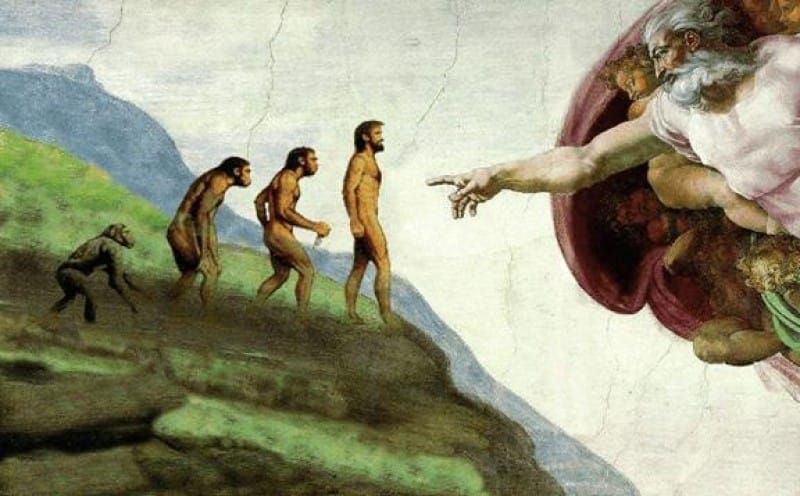
In a 2024 Roland discourse shared on his Substack, David Bentley Hart writes the following:
[M]ental agency can't be an emergent phenomenon in any strong sense, but is 'emergent' only in the sense that any particular line of organic evolution can come to participate with ever greater intensity in higher levels of mentality, higher levels of formal causality. That is, for any line of phylogeny, mentality progressively 'emerges' only in the sense that it explicates an innate capacity, the organism's inmost potentiality, and does so to the degree that the organism surrenders itself to life, so that that potency can be actualized ever more... ever more extravagantly. Again, that rules out bottom-up panpsychism, because you won't allow that some sort of primordial and aimless and non-intentional consciousness could, just as a matter of fortuity, become a truly purposive agency—a true intentionality—as that would entail the sudden appearance within physical nature of a transcendental horizon beyond anything immediate, somehow recognizable to organic systems as a value to be pursued. Rather, for you, any such intentionality would have to be preceded by an always more original desire, one within whose embrace all finite desires—all directed actions of the will toward intentional ends under finite aspects—are prompted into actuality.
It's not a straightforward passage, and I'm really not sure what's meant by "to the degree that the organism surrenders itself to life." But I understand Hart to be advocating the view that real, actual metaphysical work happens by way of natural selection. While mental agency arises from an "always more original desire" beyond the purview of biological process (I agree with Hart on this point), it progressively "emerges ... to the degree that the organism surrenders itself to life, so that that potency can be actualized ever more ... extravagantly."
In short, I'm pretty hung up on this. I agree that mind is prior – received rather than produced – but I think it's unsubstantiated to make biological evolution via natural selection itself the mechanism by which "inmost potency" gets actualized "ever more." Does deep time do metaphysical work, in this way? Why? Is that just what happens as time passes?
Elsewhere (if I remember correctly), Hart argues that history is "irrational" – the bare passage of time alone does not carry us anywhere. Is this true or not? It also seems to presume that where we've come from is less "actualized" than where we are now. Do we know this is true? Is that what we observe? What is the rubric for determining this? It's really not hard, in my opinion, to imagine a good argument for things having gone in the opposite direction.
Anyways, Hart's vision here takes on a sort-of debt that I don't think older versions of this idea carried. Gregory of Nyssa had a vision of the soul "ascending to God." Plotinus had the lower straining toward a fullness already complete above it – eternal, not achieved in time. Hegel kept things in, generally, the register of spirit and history. None of these needed a contingent, death-driven, species-level biological history to "actualize" real things. But does Hart's vision, here, need it? He's asserting that consciousness can intensify in a "particular line of organic evolution" – this claim, as it's written, ranges over the entire biosphere, every lineage subject to selection. Is that universality substantiated? I don't think so. And I think all of this demands some generalized rule that accounts for how the metaphysics of prior desire actually unfolds across the real, varied, suffering-and-death mechanics of natural selection.
I don't know Hart to have done that work. It almost sounds Teilhardian — the spiritual "work" of evolution — except Teilhard at least tried to build a cosmology around it.
So my question isn't really "where does mind come from," which is how this got started (and, admittedly, what Hart seems more concerned about answering – I recommend his book All Things Are Full of Gods on that subject). It's narrower but still, I think, important. That is, have we established that biological evolution, by way of natural selection (a process impelled as much by suffering and death as by flourishing and life), is actually doing this – "actualizing" in organisms some "inmost potentiality ... ever more extravagantly"? If so, by what rubric are we making this determination? What are we observing and measuring in order to justify this claim? And if we don't need a rubric, why not? What about the theory natural selection is sufficient to defend such a claim?
I'd suggest a rubric, myself, but I don't even know where to start.