Modernity in the Mirror: Antimodernity as Experience in Antoine Compagnon

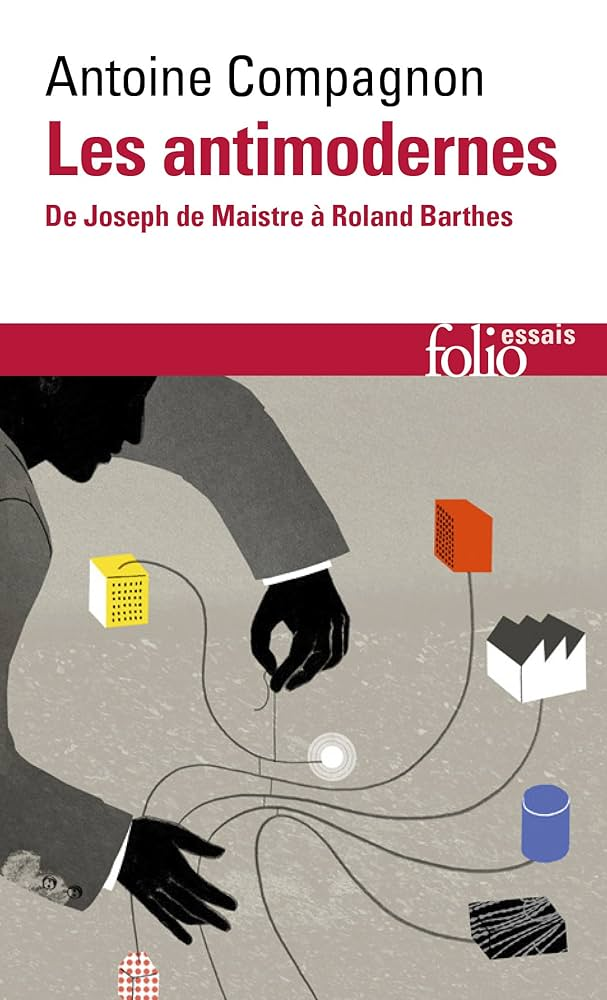
Modernity is often told as a story of emancipation, even when that story is contested. Its critics are easily classified: reactionaries, nostalgists, or belated defenders of a lost order. Antoine Compagnon’s Les antimodernes (2005) begins by unsettling this familiar arrangement. What if the most penetrating critics of modernity were not its adversaries at all, but its most lucid participants? What if modernity became intelligible only through those who, having passed through it, no longer believed its self-description?
Compagnon’s answer is disarmingly simple. The antimoderns are not outside modernity; they are within it. They are, in his recurring formulation, “at once of their time and against it,” inhabiting contradiction rather than resolving it. Antimodernity is thus not a position opposed to modernity, but one of its internal moments: its hesitation, its limit, its bad conscience. Modernity does not merely provoke resistance; it generates from within itself those who resist it most acutely.
This paradox governs the entire book. The antimoderns do not form a school, nor do they share a doctrine. What links them is something more elusive: a posture, a tone, a way of experiencing the present as both inescapable and unsatisfactory. They are modernity’s own witnesses against itself—figures who have believed, and ceased to believe, without ever leaving the terrain on which belief first took shape.
The architecture of Les antimodernes reflects this insight. Its first half does not present a theory so much as a configuration, a set of recurring figures through which this posture takes shape: counter-revolution, anti-Enlightenment, pessimism, original sin, the sublime, and vituperation. These are not detachable themes but interlocking expressions of a single historical experience, above all that of rupture. The French Revolution marks not simply a political break, but a crisis of continuity, a moment in which inheritance itself becomes problematic and the promise of progress begins to carry its own disquiet.
It is here that the counter-revolutionary tradition assumes its full significance. In Joseph de Maistre, it becomes something more than political reaction: a diagnosis of modernity’s hidden premises. Maistre does not simply defend authority; he exposes what rationalist accounts of order are compelled to ignore. Disorder, in his writing, is not an accident but a condition. Violence is not an aberration but a foundation. His striking claim that every degradation—individual or national—is immediately reflected in language binds political decay to expression itself, suggesting that corruption is inscribed in the very medium through which a society understands itself.
Such reflections do not resolve into a system. They function as pressures, as provocations directed against the optimism of modern political thought. The executioner, invoked with unsettling insistence, becomes emblematic of what modernity would prefer not to see: the obscure and troubling foundations of social order. What matters is not that Maistre explains history, but that he renders it resistant to explanation.
A similar tension informs the antimodern relation to the Enlightenment. Figures such as Edmund Burke do not reject reason, but they resist its elevation into an absolute principle. What they contest is the reduction of historical life to abstract design. Reason, they insist, must remain embedded in inherited forms, attentive to what exceeds it. The Enlightenment appears, in this light, not as a simple error but as an excess—an overextension of a legitimate faculty beyond its proper bounds.
Pessimism follows not as temperament but as experience. The antimoderns are marked by the sense that continuity has been broken and cannot be restored. They are, in Compagnon’s phrase, resigned to decadence, yet incapable of indifference to it. The theological language of original sin intensifies this perception. Humanity appears not merely imperfect but implicated, bound together in a condition that no progress can fully overcome. History ceases to be a reassuring narrative and becomes instead a field of recurrence, marked by the persistence of violence and ambiguity.
From this condition emerges a distinctive aesthetic posture. The attraction to the sublime signals a refusal of conceptual mastery; the cultivation of paradox and invective reflects a deeper intellectual tension. Antimodernity is inseparable from its manner of expression. It is not only a set of ideas but a pressure exerted on language itself—a way of writing in which lucidity and excess are held in uneasy balance.
The second half of the book turns from configuration to embodiment, tracing this posture across a wide and heterogeneous gallery of figures. These include not only foundational figures such as François-René de Chateaubriand, but also more unexpected presences such as Roland Barthes, alongside Charles Péguy, Julien Benda, and Julien Gracq. What unites them is not agreement but a shared experience of ambivalence. Each is both implicated in and estranged from the modern world he inhabits.
Péguy, for example, opposes what he calls “the modern world,” understood as a deformation rather than a mere historical phase—a world marked by cleverness, calculation, and a loss of spiritual depth. His protest is not reducible to nostalgia; it expresses a refusal of what he perceives as a flattening of experience. Benda, in turn, defends the vocation of the intellectual against what he sees as its betrayal, while Gracq’s position oscillates between attraction to novelty and suspicion of its rhetoric.
The inclusion of Barthes brings the argument to its most reflexive point. His late work stages a retreat from the imperatives of innovation toward a more oblique relation to tradition. He seeks, as he puts it, to situate himself “in the rearguard of the avant-garde,” clarifying immediately that “to be avant-garde is to know what is dead; to remain in the rearguard is to continue loving it.” The antimodern condition is thus defined not by ignorance but by divided knowledge: one sees clearly, yet does not relinquish attachment.
Compagnon does not conceal the risks of such a stance. Antimodernity can harden into bitterness, into a form of resentment that repeats its gestures without renewing them. The familiar lament that there is no longer night, no longer ceremony, no longer society captures both the insight and the danger of this posture: the perception of a world flattened by uniformity, coupled with the temptation to reduce that perception to complaint.
The book’s conclusion gathers these threads into a posture of acceptance without reconciliation. Drawing on Friedrich Nietzsche’s notion of amor fati, Compagnon describes a stance freed from illusion but not from attachment. Modernity is neither affirmed nor rejected; it is inhabited lucidly, without the expectation of resolution.
The force of this argument lies in its refusal of closure. Modernity is not a project opposed by its critics, but a condition divided against itself. Its most perceptive interpreters are those who remain within this division, neither escaping it nor resolving it prematurely.
This also marks the limit of the concept. A category defined by tension risks becoming diffuse. One may ask whether antimodernity names a distinct configuration or merely one aspect of modern consciousness as such.
Yet this indeterminacy belongs to the phenomenon itself. Antimodernity is not an identity but a discipline: a way of remaining within modernity without consenting to its illusions. It names a vigilance rather than a position.
In this sense, Les antimodernes is less a taxonomy than a meditation on lucidity. It shows that modernity’s deepest resources lie not in its affirmations, but in the resistance it cannot suppress—and perhaps cannot do without.