Rrose Crosses the Mountains

Robert Desnos had spent his youth prophesying. In the early 1920s he was the great sleeper-medium of Surrealism, falling into hypnotic states, improvising poems, drawings and predictions, and seeming at times to André Breton and the others almost frighteningly receptive to whatever might lie beyond ordinary waking consciousness. Breton famously said that Desnos “speaks Surrealist at will.” In 1925 he compiled his Three Books of Prophecies (Trois livres de prophéties); years later, on the radio, strangers would send him their dreams for interpretation. Dream, palmistry, chance, wordplay, prophecy: all belonged to that uncertain territory in which Desnos never quite allowed play and belief to separate cleanly. Yet he did not simply remain the entranced young man of 1922. By the early 1940s he could describe automatic writing and automatic speech as merely the elementary stages of poetic initiation, doors opened onto something more conscious and difficult. What had begun as experiment was becoming, increasingly, a way of conducting oneself.
Then the country changed. Desnos entered the Resistance during the German occupation and was arrested by the Gestapo on 22 February 1944. He passed through Compiègne, Auschwitz-Birkenau, Buchenwald and Flossenbürg, then Flöha, a satellite camp of Flossenbürg, before the final death march carried him to Theresienstadt. Yet the habits of his old Surrealist life followed him into deportation in altered form. His companions remembered him telling stories, interpreting dreams, exchanging recipes, making jokes—and reading palms.
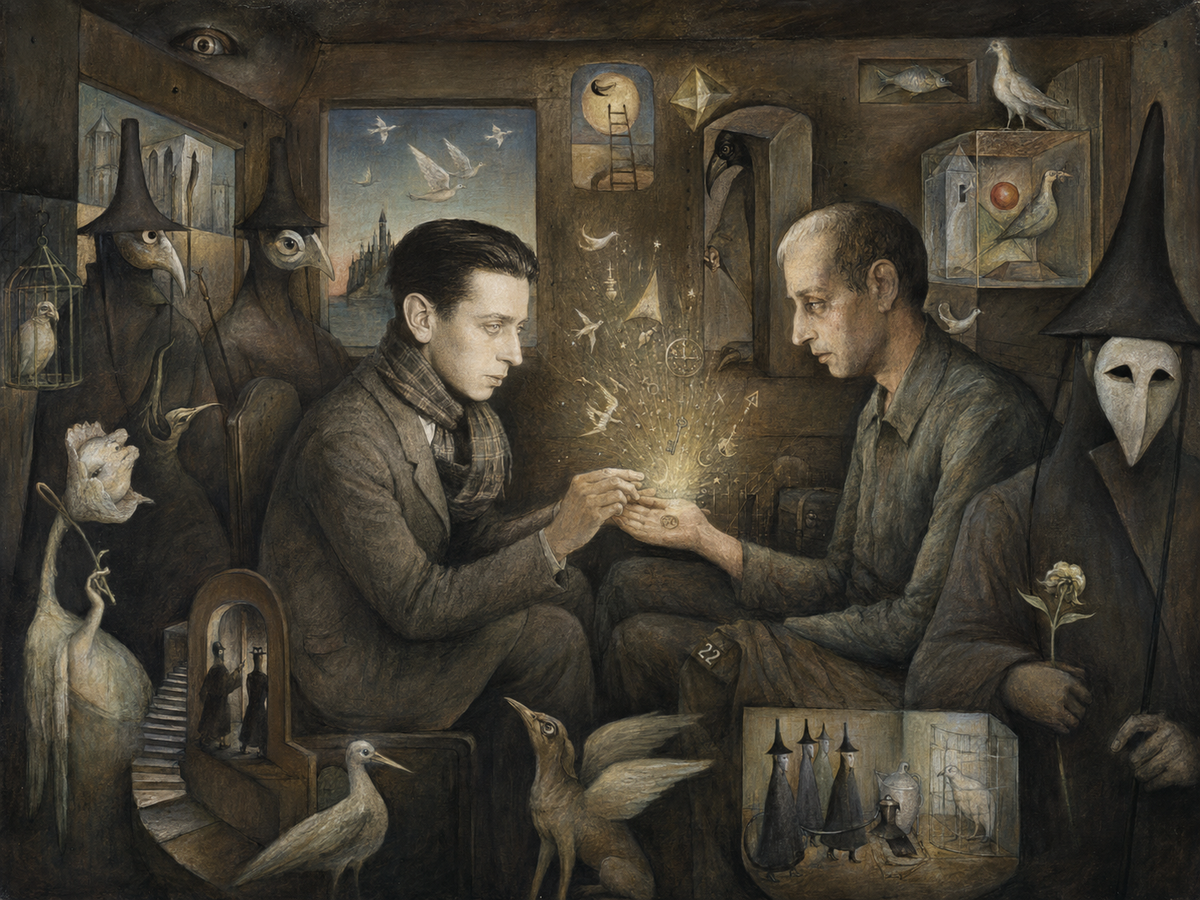
The famous version of the palm-reading story is almost too perfect. A group of prisoners is supposedly being carried in a truck to its death when Desnos suddenly takes the hand of the man beside him, examines it, and pronounces the whole situation impossible. This is the hand of a man who will live a very long time; here, moreover, are children—three of them. Other hands appear, and Desnos begins discovering long lives everywhere: marriages, journeys, old age, happiness. There seems to have been an administrative error. The SS has the lists; Desnos has the hands. In the most marvellous version, the contradiction becomes so infectious that even the guards lose their certainty and the execution is abandoned.
That exact scene cannot presently be established. The dramatic truck-and-gas-chamber version enters the traceable printed record in Susan Griffin’s 1996 essay “To Love the Marigold,” where she says it was told to her by a Holocaust-survivor friend named Odette. It is probably best regarded as a legend in which things Desnos genuinely did have condensed into a single exemplary episode. What he actually did scarcely needs improvement.
André Bessière, who was deported with him, remembered Auschwitz-Birkenau as an écurie de la mort, a stable of death, saturated with rumours that their deaths had already been programmed. While men around him were beginning to collapse inwardly under that prospect, Desnos went from group to group, took their hands, read their lines and invented futures for them. Whatever adventures befell each man, Bessière remembered, they always ended happily. Desnos spoke about these futures with such assurance that men who had been sinking into despair began to hope again. On Sundays he interpreted their dreams, usually humorously; at night he told stories of Paris and the painters, poets and friends he had known.
Bessière is not our only witness. André Verdet travelled with Desnos through Compiègne, Auschwitz and Buchenwald; Henri Pfihl and Pierre Volmer knew him at Flöha. Marie-Paule Berranger, drawing these testimonies together with Desnos’s correspondence, finds the same cluster of practices recurring: dreams, recipes, fortunes, stories, laughter, long lives confidently announced against the evidence. She describes Desnos’s deliberate cultivation of humour and optimism as a kind of “combat sport.” This was not a failure to understand the situation. Desnos had already warned in wartime correspondence against imagining that present events were definitive, or that the future lay wholly beneath their power; he could wish someone a long life and much laughter still to come while insisting, in the same breath, upon keeping both feet on the ground.
Was the palmistry a joke? Certainly, in one sense. Surrealist black humour does not make suffering unreal; it refuses to grant an intolerable reality complete sovereignty over the mind. Desnos could joke about the lice in the camps by assigning them military ranks. The palm-reading contains the same exquisite disproportion: a modern state possesses files, classifications, railway schedules, selections, rifles; Desnos bends over a crease in somebody’s hand and announces that its information is incorrect.
But I doubt that it was only a joke. Desnos had spent more than twenty years exploring precisely the region in which poetic invention passes into divination, coincidence seems to answer a question, and words occasionally appear to know something before their speaker does. His Three Books of Prophecies were not simply a parody of prophecy. The old Surrealist games occupied a territory in which pretending and discovering, play and seriousness, could cross into one another without warning. Perhaps Desnos knew perfectly well that he was inventing these futures; perhaps some part of him believed them; perhaps belief could enter through the invention. The palm-reading could be black humour, theatre, friendship, prophecy, magic and resistance without requiring us to decide which of these it “really” was.
There is a deep continuity here with the question posed by the first Manifesto of Surrealism. Breton had asked whether dream might cease to be a sealed private realm and enter into the fundamental problems of life, whether dream and waking existence might disclose themselves as parts of a more encompassing surréalité. Desnos was one of the people whose extraordinary performances during the early Surrealist sleeps had helped make such a proposition conceivable. Twenty years later the same question returned under circumstances none of them could have imagined: what can the faculty cultivated in dream actually do when waking life has become Auschwitz?
Desnos does not escape Auschwitz by dreaming; he brings the dream into Auschwitz. The old capacities remain recognizable—improvisation, dream interpretation, prophecy, the willingness to follow an image beyond what ordinary probability permits—but their direction has changed. The young Desnos had sometimes prophesied death. Now, surrounded by death, he prophesies life.
Breton’s later The Communicating Vessels gives an apt name to the traffic involved. Dream and waking life, desire and circumstance, inner and outer reality are not sealed compartments; what happens in one passes into the other. Here the movement is reciprocal. The camps transform Desnos’s old prophetic practice, and the transformed practice acts in turn upon the men inside the camps. Prophecy ceases to be an announcement of strange destinies and becomes the production of futures for people being taught that they have none. The future imagined may not exist yet, but its effect belongs entirely to the present: Bessière tells us that men who had begun to despair began again to hope.
Desnos knew perfectly well that imagination could not substitute for material action. In the Resistance he had helped produce false papers—names and identities with practical consequences, capable of moving a person through the machinery of persecution. There is something almost painfully exact in the continuity: in the Resistance he helped forge documents; in deportation he forged futures. One kind of invention interfered with the bureaucracy of persecution; the other with its attempted conquest of consciousness.
And perhaps the hand itself tells the story more simply than any theory can. Under forced labour, a hand carries, lifts, digs, obeys. Desnos takes the same hand and reads something else in it: a road, a marriage, old age, children, years. The camp has one account of what this body is and what will become of it. Desnos refuses to concede that the account is complete.
Berranger describes the future he created for his fellow prisoners as a kind of futur antérieur necessary to survival: the future perfect, the present regarded from a point beyond catastrophe. Not simply, perhaps you will survive, but: you will have survived this; you will have travelled; you will have loved; you will have grown old. For a man whose future is being methodically abolished, even the tense contains a kind of freedom.
This reaches surprisingly far back into Desnos’s own thought. In 1925, during the same period as his prophetic experiments, he could write extravagantly of eternity and resist the idea that spiritual life was exhausted by chronological succession. Prophecy, for him, was never merely a technique for guessing what would happen next. It belonged to a larger refusal to grant the present arrangement of reality absolute jurisdiction over what a person was or might become.
The last evidence for this continuity comes from Desnos himself. Youki—Lucie Badoud, formerly the model and companion of the Japanese-French painter Tsuguharu Foujita—had lived with Desnos from 1931 until his arrest and was the great love and daily companion of his mature life. After his arrest she tried repeatedly to locate him and prevent his deportation. On 7 January 1945, from Flöha, Desnos wrote her his last surviving letter. Much of it is almost startlingly practical: parcels, books, money, friends, clothes, his affairs in Paris. Then, without much ceremony, comes the sentence: Pour le reste je trouve un abri dans la poésie—“For the rest, I find shelter in poetry.”
And then he reaches back twenty-three years to Rrose Sélavy, Marcel Duchamp’s female alter ego, whom Desnos had borrowed during the early Surrealist sleeps and made into a kind of poetic double of his own. Among the punning, oracular aphorisms he published under her name in 1922 was this: Rrose may put on the convict’s garb, but she has a mount that crosses mountains. Now, writing from an actual camp, Desnos says that the old saying is justified for him “word for word.” The games of the early 1920s had followed him all the way to Flöha; something written in play had waited more than twenty years for circumstances terrible enough to disclose what else it could mean.
Desnos reached Theresienstadt at the end of the death march. The camp was liberated, but he had contracted typhus. He died on 8 June 1945. The prophet of long life received very little of the liberated future himself, but for a time, according to the men who were there, he had given futures to others.
The camp had already read the prisoner’s future. Desnos took his hand and read it again.