Can vicarism save me?
We cast our sins on a scapegoat and call it grace. But what if we were built to carry them? Is vicarism our curse or our salvation?

I continue to be surprised (to my shame, at this point, after 35 years of life) how many people are content to live their lives vicariously through someone else – to experience most of what the world has on offer through pixels on a screen that resemble, but (in our AI age) may not actually represent, some figure whose life observed is, somehow, enough.
John Steinbeck in East of Eden (I've quoted this here before):
And the families did survive and grow. They had a tool or a weapon that is also nearly gone, or perhaps it is only dormant for a while. It is argued that because they believed thoroughly in a just, moral God they could put their faith there and let the smaller securities take care of themselves. But I think that because they trusted themselves and respected themselves as individuals, because they knew beyond doubt that they were valuable and potential moral units — because of this they could give God their own courage and dignity and then receive it back; such things have disappeared perhaps because men do not trust themselves any more, and when that happens there is nothing left except perhaps to find some strong sure man, even though be may be wrong, and to dangle from his coat-tails.
To desire somebody like this – a hero, a Messiah – seems pretty well baked in to our psyches, it seems. The "journey of life" is fulfilled for so many by finding and watching a hero "get-er-done" (or whatever).
It all raises questions, for me, about the purported Messiah, from Nazareth. Because vicarious living (and, by extension, vicarious substitution as a our vehicle for salvation, and for epektasis) seems so obviously inadequate. Are we really primed by our relations with God and with each other for a posture of, fundamentally, observance? Of watching? Of waiting, and that's it?
Is this all there is to it, all there is to be? A waiter? Are we cosmic couch potatoes, engaging with the fullness of being through something akin to radio signals from somewhere far, far away?
In the quote above, Steinbeck insinuates that vicarism is an evil – that it marked the end of the pioneer spirit, whereby life was truly lived and even sacrificed (one cannot, after all, make a vicarious sacrifice of themselves). I think I agree with this framing, and I suppose, in my mind, any figuration of "Messiah" worth its salt really ought to look more like gazing into a mirror that shows us our true selves, and less like "adoration" of some other figure. This is a Christological personalism, if you will – a "God as ground-of-being" (manifest, indeed, in a human being) who is not greater, in some sense, than are we, and so whose incarnation represents his fullness and demonstrates the nearness of the divine ("you are gods...", after all). In fact, this is what I insist on gleaning from Christ, even when the whole thing seems to be, somehow, up to me alone (which is not, I admit, what one might expect from a "savior," and certainly not something that seems very...impressive).
But is this just some longing I have – one perhaps borne of some deficiency or hubris or disordered desire to be something more than the pathetic being that I am? Do I even have any evidence, really, that I, or any man, is meaningfully capable of more than this (because we can't even adore very well, can we?)? Of more than to gaze?
But maybe that's because we are built for something more. Something different.
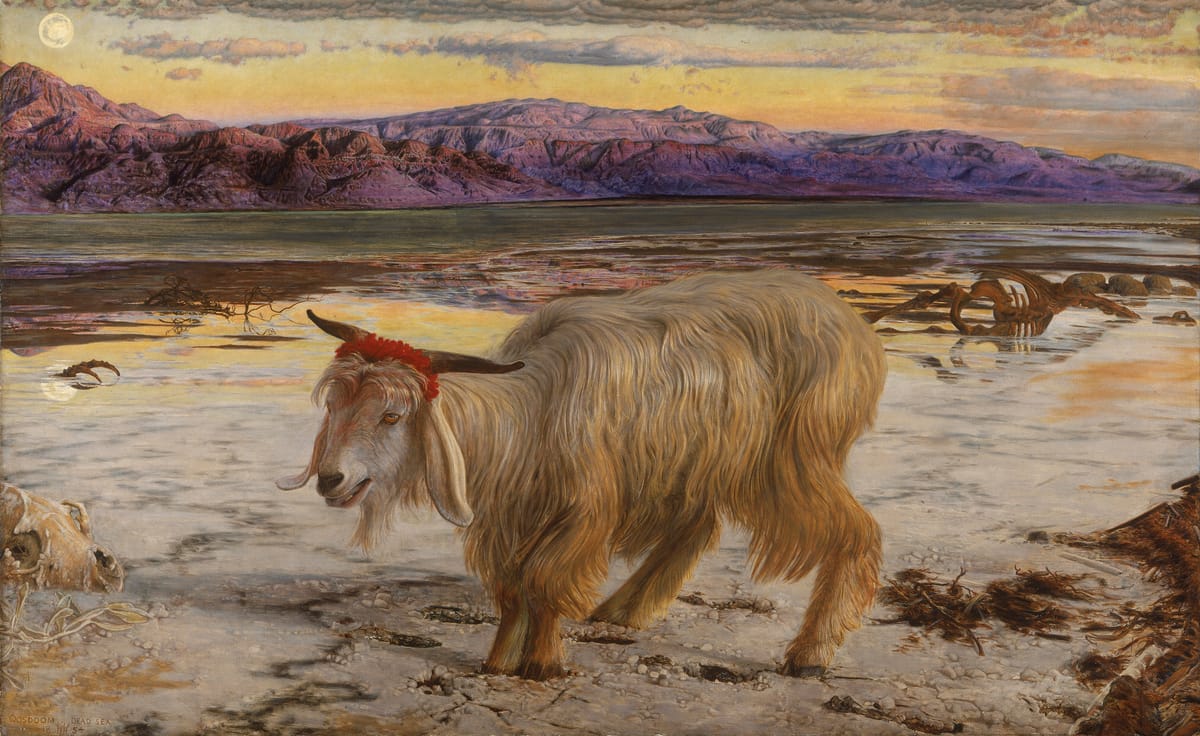
We cast our sins upon a scapegoat because we can't bear their burden, really, on our own. In this way, we are removed from our sins, and we call this God's grace. But insofar as a life with God entails more than sending our sins out into the wilderness and, instead, calls us to ascend, isn't vicarious living our great evil temptation? Is it not hypocrisy? Is not it the very sort of thing our Christ curses and removes?
"Do not hold me, but go..." ~Jesus (to Mary Magdalene)
But alas, Christ is far from us – a distant memory. I couldn't even hold him if I wanted to. He is an inherited and inculturated posture whose source material is far beyond (if I'm being honest, and the more I learn) the purview of my post-modern milieu. Even Eucharist, so blessed, is like an untranslated codex, it being devoid of (almost) all but pure mystery, unadulterated by what little I might bring to it with confidence (that is, it lacks mental substance) – of what little, that is, which bestow upon such mysteries any organic value.
But I suppose it is the "convention" of Eucharist (and, perhaps, of all religious things) that makes it...religious. Simone Weil writes:
Only a convention can the perfection of purity here below, for all nonconventional purity is more or less imperfect. That a convention should be real, that is a miracle of divine mercy. ... Even the presence of Christ in human flesh was something other than perfect purity, since he censured the man who called him good, and since he said: "It is expedient for you that I go away." He must then be more completely present in a morsel of consecrated bread. His presence is more complete inasmuch as it is more secret.
So when I long for something more, is it even possible? Or, if not, then is it some disordered longing that can only ever leave me – us – unsatisfied?
Vicarism is the enemy. Yet vicarism is all we have, and convention is the only thing pure. Do we, perhaps, have only dry "forensics," after all?
I think not. Or, rather, I believe not – this is simply a fundamental conviction of mine. It's my "work of faith." There is something more than that, though I can rarely see it.