Thomas Troward and the Science of Mind

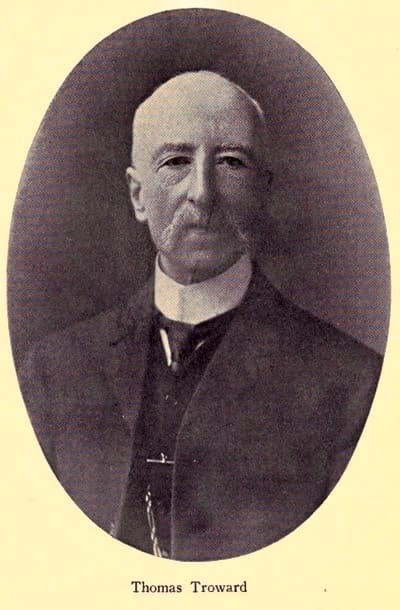
Thomas Troward (1846–1916) occupies a distinctive and, in many respects, indispensable place within the movement later called New Thought. Where much of that current tended toward exhortation, therapeutic promise, or loosely articulated metaphysics, Troward sought to supply what it otherwise lacked: a principial foundation. His project was not to popularise a method but to demonstrate a structure. Trained as a judge in British India, he brought to spiritual inquiry the habits of legal reasoning—precision of definition, consistency of inference, and a refusal to admit conclusions not grounded in principle. The result is a body of work that, within its milieu, stands apart for its coherence and intellectual discipline.
The circumstances under which this work emerged are themselves instructive. After a long career in India, Troward returned to England with a developed but unpublished system of thought. As a contemporary account records, he brought with him “a mass of manuscripts containing a system of philosophy he believed unique,” and for a time remained outside public view. His eventual entry into public life came not through self-promotion but through the recognition of others, particularly within the Higher Thought Centre in London. There he delivered the lectures that would become The Edinburgh Lectures on Mental Science (1909) and, shortly thereafter, the Doré Lectures: not introductory addresses, but the public articulation of an already formed philosophy.
Our knowledge of Troward’s life is due in large part to Harry Gaze, an American lecturer and organiser within the early twentieth-century metaphysical movement, who knew him personally and published Thomas Troward: An Intimate Memoir of the Teacher and the Man in 1917. Gaze’s account is not a detached biography but a work of recollection and interpretation, and must therefore be read with some critical reserve. Yet it preserves invaluable details: Troward’s initial reluctance to lecture, his quiet humour, and his characteristic modesty. It also records his own half-playful remark that he did not know whether he was “a writer who paints pictures” or “an artist who writes books,” a remark that points to the distinctive interplay of abstract reasoning and vivid illustration in his prose. Through Gaze’s testimony, Troward appears not as a self-promoting figure but as a thinker whose ideas gradually compelled recognition.
Troward’s preferred name for his enterprise—Mental Science—is significant. By it he meant not a body of inspirational teaching but an inquiry into law: the determination of the principles governing the relation between mind and manifestation. The starting point of that inquiry is the recognition that the observable order of the world implies an underlying unity of principle. Reality, as he understands it, is not a juxtaposition of independent facts but the expression of a single, intelligible process. The task is therefore to think from that process rather than from its appearances—to proceed from cause to effect, not from effect to cause.
At the centre of this process stands what Troward calls the Universal Mind: not an abstraction, but a living, self-knowing principle whose activity consists in the production of form. The individual mind is not external to this principle but a localisation of it—a point at which the universal becomes determinate. The distinction is therefore not between two separate orders of being, but between the originating and the determining phases of a single activity. The universal is creative; the individual is directive. Without the universal there is no power; without the individual there is no form. The relation is thus reciprocal in function, though not in origin.
From this follows Troward’s doctrine of mental causation, often simplified by later writers but in his own work carefully delimited. Thought is effective, not because it overrides reality, but because it participates in the same process that produces reality. The inner and the outer are not parallel domains but successive moments of one continuous operation: what is first implicit in thought becomes explicit in condition through the mediation of law. The effectiveness of thought is therefore proportional to its conformity with principle. To think from appearances—to take conditions as primary—is to reverse the order of causation and to render thought ineffective.
It is in The Creative Process in the Individual (1910) that this structure receives its most exact formulation. There Troward distinguishes between the generic movement of nature and the specific initiative of the individual. Nature repeats; the individual originates combinations. Yet this originality does not consist in breaking with law but in applying it at a higher level of consciousness. “Principle is not bound by precedent,” he writes, indicating that the constancy of law is the very condition under which novelty becomes possible. The individual’s role is thus neither to submit passively to given conditions nor to oppose them arbitrarily, but to recognise the principle at work and to direct it intelligently.
The balance of dependence and initiative at the heart of this view is captured in one of Troward’s most precise formulations: “It is not I that work but the Power; yet the Power needs me because it cannot specialize itself without me.” The sentence resists reduction. It denies both self-sufficiency and passivity. The individual is not the source of power, yet neither is it dispensable; it is the point at which power becomes particular. Hence his further insistence that human beings are “required, by the law of our own being, to take a more active part in our personal evolution than heretofore.” Freedom, in this system, is not exemption from law but participation in it at the level of understanding.
The essays collected in The Hidden Power and Other Papers upon Mental Science (1921), published posthumously, present the same doctrine in a more interior and reflective mode. Here Troward emphasises the invariability of the law across all planes and the centrality of the individual as the point of application. Each person, he suggests, stands at the centre of his own field of expression, not as an isolated ego but as a locus in which universal principles take determinate form. The shorter essays, including “The ‘I AM’,” condense his argument to its experiential core: the recognition that the self, properly understood, is not confined to its manifested aspect but grounded in the same universal principle from which all manifestation proceeds.
Gaze’s summary of Troward’s teaching provides a useful complement to these more formal expositions. He describes it as centred on the idea of a “Self-Originating and Affirmative Spirit,” and on the principle that creation proceeds through the “Self-Contemplation of Divine Spirit.” These formulations, though more devotional in tone, correspond closely to Troward’s own position: that reality is the expression of a self-knowing principle, and that the individual participates in that expression as a centre of consciousness. The power attributed to thought is thus not personal in origin but universal in nature, becoming effective only insofar as the individual aligns with the mode of its operation.
In his later, posthumously published writings, including The Law and the Word (1917), Troward extends these principles into a more explicitly theological register. Yet the movement is not a departure but a development. If the universal is a self-knowing spirit, and if the individual is a centre of its self-expression, then the progressive realisation of their unity follows as a logical consequence. Even here, however, Troward proceeds by inference rather than appeal: what is affirmed must be shown to follow from what has already been established.
Taken together, Troward’s life and work exhibit a rare consistency. The biographical elements—his legal training, his Indian service, his late entry into public discourse, and his association with the Higher Thought milieu—are not external to his philosophy but conditions of its formation. The writings themselves form a continuous argument: that reality is grounded in a universal, intelligible principle; that the individual is a centre of its determination; that thought operates causatively within a law-governed process; and that human development consists in the conscious recognition and application of that process. Within the heterogeneous field to which he is often assigned, Troward remains distinctive not for the novelty of his themes but for the rigour with which he formulates them. His enduring importance lies in having shown that what is often presented as inspiration can, in fact, be understood as law.