Josiah Royce and the Destiny of the Individual
The question of immortality cannot be answered until we know what an individual truly is. Before we ask whether the self survives, we must ask what sort of being the self is.

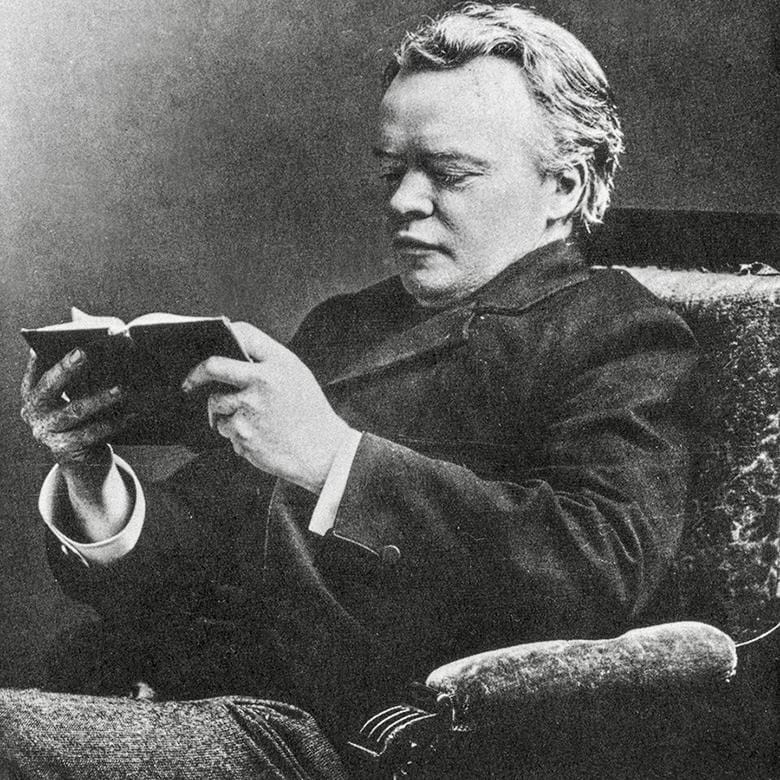
At the close of the nineteenth century, when scientific naturalism was ascendant and traditional metaphysics appeared exhausted, a quiet but formidable American philosopher delivered a lecture at Harvard that reframed one of humanity's oldest questions. Josiah Royce's 1899 Ingersoll Lecture, The Conception of Immortality, does not defend survival after death by appeal to consolation, sentiment, or ecclesiastical authority. Instead, it performs a reversal. The question of immortality, Royce insists, cannot be answered until we know what an individual truly is. Before we ask whether the self survives, we must ask what sort of being the self is in the first place.
This move reveals the distinctive character of Royce's philosophy. He belongs to the high moment of Absolute Idealism—a tradition that includes T. H. Green, F. H. Bradley, Bernard Bosanquet, and J. M. E. McTaggart—yet he stands apart from his British counterparts in both tone and development. Where Bradley subjects the categories of common sense to dialectical dissolution in Appearance and Reality, and McTaggart constructs an austere pluralistic metaphysics of eternal spirits, Royce builds his system from a theory of meaning, error, and interpretation. His Absolute is not an impersonal experiential whole nor a mere logical totality; it is a self-conscious life in which every fragmentary finite meaning is fulfilled.
The Ingersoll Lecture sits at a decisive juncture in Royce's intellectual trajectory. In the years immediately surrounding it, he was delivering the Gifford Lectures that would become The World and the Individual. There he elaborated a comprehensive metaphysics in which being is defined as the fulfilled object of an idea. An idea, for Royce, is not a passive mental copy but a purposive intent that seeks determinate embodiment. Error is possible because our finite ideas are fragmentary; they aim beyond what they presently achieve. From this he derives a radical conclusion: reality must be that complete fulfilment in which all such fragmentary intentions find their final coherence. The Absolute is therefore the all-inclusive, perfectly determinate interpretation of the world—a Self in whom every finite act of meaning is eternally integrated.
The Ingersoll Lecture distils this system to its existential core. When Royce argues that individuality cannot be captured by sense or by abstract thought, he is not merely making an epistemological observation. Sense presents recurring qualities; thought yields universals and classes. Neither gives the strictly unique. Individuality is not a content that can be exhibited; it is a significance that is intended. We encounter it most vividly in love, loyalty, and moral devotion, where we mean not a bundle of traits but an irreplaceable being. The language of affection may be general, but its aim is singular. Individuality belongs, therefore, not to the sphere of description but to that of fulfilment.
Here the lecture intersects with the broader concerns of Absolute Idealism. The tradition had long sought to reconcile unity and plurality, to show how the many could be real without fragmenting the whole. Royce's distinctive answer is that individuality consists in a unique office within an ordered system of meaning. A finite self is not a self-subsisting substance; it is a centre of interpretation occupying an irreplaceable standpoint within the Absolute life. The unity of the whole does not abolish distinctness; it organises it. Reality is not a mere aggregate of externally related facts, but a rational and purposive whole in which every fragment has its determinate place.
From this standpoint, immortality is no longer an appendage to metaphysics; it is an implication. Our present existence is manifestly fragmentary. We strive, err, suffer, and only partially realise what we mean. Time is the form of this incompleteness. Yet if individuality consists in a unique significance within the eternal system of meaning, then that significance cannot be exhausted by its temporal appearance. Eternity is not endless duration but the complete possession of a life's meaning within the Absolute. Immortality, accordingly, does not signify the indefinite prolongation of the empirical ego. It names the consummation of personal uniqueness—the final and eternal fulfilment of that individual significance which finite existence only imperfectly embodies.
Within the wider landscape of Absolute Idealism, Royce's position is at once faithful and innovative. Like Green and Bradley, he affirms that reality is spiritual and that the finite finds its truth in the whole. Unlike Bradley, he resists the suggestion that relations dissolve into an ineffable immediacy; for Royce, interpretation and community are not illusions but the very form of the Absolute. Unlike McTaggart, he does not ground immortality in an a priori proof of the unreality of time; rather, he grounds it in the structure of meaning itself. The Absolute is not an abstract One beyond all difference, nor a mere collection of eternal individuals. It is a self-conscious, internally articulated life—an eternal community in which each finite self has an irreplaceable role.
Why does this matter now? In an age once again tempted either by reductive naturalism or by vague spiritualism, Royce offers a disciplined alternative. He refuses to diminish the individual to a biological accident, yet he equally refuses to detach individuality from an ordered whole. His vision affirms that each life bears a unique and enduring significance, not because of subjective preference, but because reality itself is structured as the fulfilment of meaning. The destiny of the individual is not absorption into indistinction nor isolation in eternal solitude, but participation in a life whose unity deepens, rather than cancels, personal distinctness.
To read The Conception of Immortality is therefore to encounter Royce at a point of luminous compression. The lecture gathers the metaphysical rigor of his larger system and directs it toward a question that concerns every reflective soul. It is an invitation to reconsider what it means to be an individual in a world that is more than accidental, and to imagine eternity not as endless repetition but as the complete and conscious possession of one's true significance. In Royce's hands, immortality becomes not a comforting hypothesis but the natural flowering of a metaphysics in which meaning is ultimate and no genuine individuality is ever lost.
The Ingersoll Lecture, 1899.