From Emptiness to Logos: Fabien Muller’s Kenological Retrieval of the Johannine Prologue

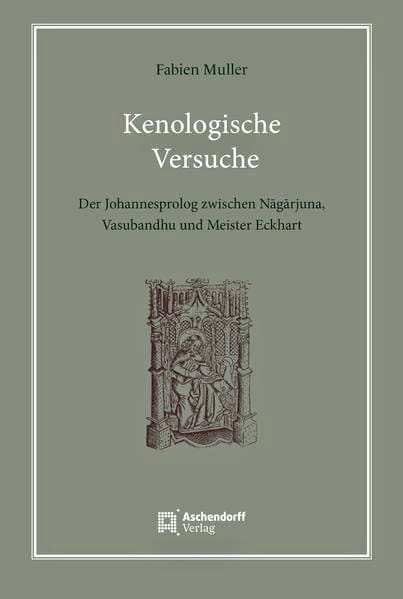
Fabien Muller's Kenologische Versuche: Der Johannesprolog zwischen Nāgārjuna, Vasubandhu und Meister Eckhart (Kenological Essays: The Johannine Prologue between Nāgārjuna, Vasubandhu, and Meister Eckhart, 2022) is one of the most ambitious recent attempts to recover the Johannine Prologue as a text of first philosophy. It is neither a work of comparative religion in the conventional sense nor a historical-critical reconstruction of sources. It is a systematic philosophical argument that moves—deliberately and rigorously—through three great speculative constellations: Madhyamaka emptiness, Yogācāra mind-metaphysics, and Eckhartian intellect, in order to retrieve the Logos of John 1 as the absolute self-articulation that grounds being precisely in the emptiness of all finite determination.
The book begins from an image drawn from Ignatius of Antioch: Christ as the Word "come forth from silence." Muller radicalises this image. The Johannine Prologue stands within a double silence. There is first the historical silence: more than a century of scholarship—from Rudolf Bultmann’s gnostic hypothesis to subsequent appeals to Hellenistic Judaism, Middle Platonism, syncretism, and apocalyptic—has not produced a decisive account of the Prologue's origins. The "overall problem" of John 1 remains unresolved. There is second the philosophical silence: the Prologue itself offers no explanation of its decisive terms—"beginning," "Word," "God," "life," "light." Historical criticism has attempted to dissolve the first silence; speculative evasion has often deepened the second.
Muller's response is methodological. Instead of grounding interpretation in historical coherence—locating the Prologue within a reconstructed intellectual milieu—he proposes systematic coherence as the governing criterion. A text may be rendered intelligible either by reconstructing its context or by unfolding the inner necessity of its conceptual relations. Muller chooses the latter without denying the former. The question is not where the Prologue came from, but how its claims about beginning, Word, and God can be articulated as a coherent account of first principle. The Prologue must be allowed to "speak" again—but it can only do so through a philosophical movement capable of carrying its silence.
That movement begins with Nāgārjuna. Muller’s reconstruction of Madhyamaka is explicitly polemical. He engages contemporary Anglophone scholarship that interprets śūnyatā as semantic therapy (Mark Siderits), conceptual deflationism, logical paradox (Graham Priest and Jay Garfield), epistemological strategy, or purely soteriological device (Michael Sprung). Against these anti-metaphysical readings, Muller argues that Nāgārjuna’s denial of svabhāva concerns the being of things themselves. Dependent origination is not a linguistic convention but an ontological disclosure: all determinate entities lack intrinsic self-grounding. Emptiness is therefore not a nihilistic void nor merely a critical method. It is the structural non-self-subsistence of all finite being.
Yet this metaphysical interpretation immediately generates tension. If all things are empty of intrinsic being, how is determinacy possible? How can cognition, discourse, and the functioning of the world persist? Nāgārjuna’s doctrine of the two truths safeguards conventional reality, but it does not positively account for the appearance of structured experience. Emptiness threatens to dissolve the world it simultaneously preserves. It is precisely this unresolved tension that necessitates the transition to Yogācāra.
The second movement turns to Vasubandhu’s Triṃśikā. Here Muller again positions himself against dominant currents in contemporary interpretation. The influential phenomenological reading of Yogācāra—advanced by figures such as Dan Lusthaus, Dan Arnold, and others who situate Yogācāra in dialogue with Husserlian and Heideggerian analyses of subjectivity—is rejected. Muller argues that Vasubandhu is not primarily a phenomenologist of experience but a metaphysician of mind.
Through the doctrine of the three natures (trisvabhāva), Vasubandhu exposes subject–object duality as a distortion arising within consciousness. Apparent objectivity is not an independently existing realm but the manifestation of consciousness structured by karmic seeds and conceptual construction. The ultimate level is not an external being but the suchness (tathatā) of mind beyond dualistic projection. In this way Yogācāra provides what Madhyamaka leaves open: emptiness does not culminate in indeterminate negation but in a positive account of absolute mind. Being and emptiness are reconciled at the level of non-dual consciousness.
Muller insists that this is a metaphysical claim in the classical sense—a claim about the fundamental structure of reality—not merely an analysis of experience. Mind is not simply the horizon of phenomena; it is the ground in which phenomena arise. With this move the speculative trajectory becomes visible: from the emptiness of finite being to the ultimacy of mind.
The third movement crosses into the Greek and Christian tradition through Meister Eckhart. Muller focuses on Eckhart’s prima Quaestio Parisiensis, in which the Dominican master argues for the primacy of intellect over being in God. Against late-medieval debates over whether being (esse) or intellect (intellectus) is primary in the divine nature, Eckhart maintains that God is intellect before he is being. This thesis allows Muller to establish a structural parallel with Yogācāra’s absolutisation of mind while situating it within the metaphysics of νοῦς inherited from Middle Platonism and Christian theology.
Eckhart’s claim is radical: the divine intellect is the self-reflexive act in which God knows himself, and in this act all being is grounded. Being derives from intelligibility; intelligibility does not derive from being. This reversal becomes decisive for the reading of John 1. "In the beginning was the Word" is interpreted as the primacy of Logos—understood not merely as speech or mediation, but as the eternal act of divine thinking. The Prologue is thus read as a metaphysical declaration: before every determinate being, before every created essence, there is the self-articulating intellect in which all things are conceived.
Muller does not collapse Buddhism into Christianity, nor Christianity into Buddhism. Instead, he constructs what he calls a kenological architecture. From Nāgārjuna he takes the radical negation of intrinsic self-being; from Vasubandhu, the positive articulation of absolute mind; from Eckhart, the primacy of intellect as Logos. Kenology becomes the speculative discipline that shows how the absoluteness of the Logos can be grasped only when all presuppositions—including the presupposition of being—are emptied.
The structure of the argument is circular. Emptiness leads to mind; mind leads to Logos; Logos in turn illuminates emptiness. Each moment both negates and confirms the others. No tradition is subordinated; no element is declared culturally obsolete. Muller explicitly rejects theological projects that attempt to overcome "Greek ontotheology" by replacing it with Buddhist categories (as in certain readings of John Keenan), just as he rejects the deconstruction of metaphysics as such. The Greek dimension of Christian theology—especially the concept of Logos—is not a dispensable cultural accident. At the same time, Buddhist philosophy is not reduced to a preparatory stage for Christian doctrine. Instead, both are drawn into a single speculative movement in which each attains fuller intelligibility through the other.
Throughout the book Muller critiques modern paradigms: historical reductionism in Johannine scholarship; anti-metaphysical interpretations of Madhyamaka; phenomenological domestications of Yogācāra; revisionist attempts to sever Christian theology from its Greek inheritance. Against these, he defends the possibility of a renewed metaphysics—not as a return to pre-critical dogmatism, but as a systematic articulation capable of thinking first principle across traditions.
The Johannine Prologue thus emerges as neither a relic of Hellenistic religiosity nor merely a poetic christological hymn. It becomes a speculative meditation on origin: on beginning as intelligible act; on Word as self-relation; on God as the ground in which being is spoken. When read through the kenological arc from emptiness to Logos, the Prologue no longer stands in mute historical opacity. It speaks from within the silence of emptied determination. The Word that "was in the beginning" is disclosed as the self-grounding intelligibility in which the world arises—not by overcoming emptiness, but by articulating it.
In this way Muller's work proposes nothing less than an intercultural rehabilitation of metaphysical theology. By passing through Nāgārjuna and Vasubandhu before returning to Eckhart and John, he seeks to show that the Logos can be thought most radically when every finite ground has been relinquished. The Prologue becomes what it always intimated: not simply the beginning of a Gospel, but a philosophical disclosure of first principle—absolute intelligibility arising from the kenosis of all presupposition.
Muller's introduction for the Center for the Study of World Religions, Harvard Divinity School